Why The Restoration

A manifesto on Christendom, classical formation, and the work the saints were always asked to do.

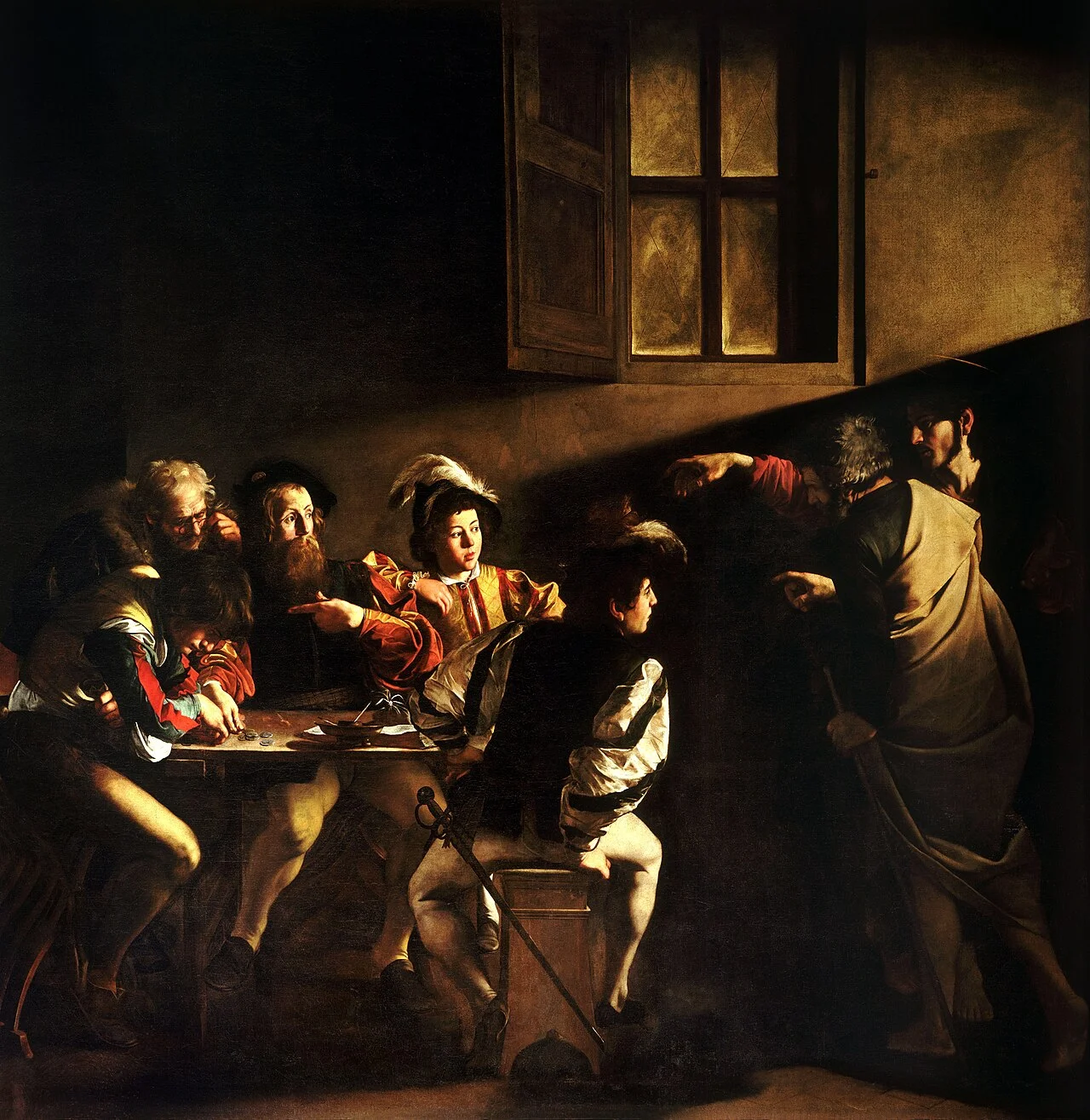
Caravaggio, The Calling of St. Matthew (1599-1600). Oil on canvas, Contarelli Chapel, San Luigi dei Francesi, Rome.
Caravaggio · The Calling of St. Matthew · 1599–1600 · Contarelli Chapel, San Luigi dei Francesi, RomeChrist's hand breaks in from the right — the same posture as Adam's in Michelangelo's ceiling — and calls a tax-collector out of the counting-house of the world. Every restoration begins here.

The West is post-Christian. You know this. You feel it in the school-board meeting where the chaplain has been replaced by a diversity officer, in the parish where the tabernacle has been moved to a side chapel and the sanctuary repainted in beige, in the city block where three Catholic grade schools used to stand and now there are none, in the home where the children cannot recite a single psalm, in the court where a Catholic hospital is sued for refusing to do what the Fifth Commandment forbids. You feel it in the silence at the end of the rosary when no one knows the next decade. You feel it in the empty pew where your father knelt.

The temptation when you see all this is to manage the decline. To preserve what is left. To become a chaplain to a dying order and call it fidelity. To trade prophecy for chaplaincy and call the trade prudence.

That temptation must be refused.

What is needed is not a rear-guard action. What is needed is a restoration — sober, generational, rooted in the concrete work of forming souls who can carry the Faith forward into the century in front of us. Not a longing for the past. A building of the future on the bones of what was never wrong. The bones are good. They were laid by Christ Himself.

I write as a husband, as the father of Ben and Eva, a Navy veteran who has stood watch in dark waters, a cardiac surgical first assistant who has held a stopped heart in his hands and watched it begin again under the touch of grace and skill, former president of the largest Catholic K-12 school in the country, a co-founder of two schools, a graduate student in theology at Holy Apostles. Not as a pundit. Not as a prophet. As a practitioner with a clear stake in whether the next generation receives the Faith intact. This essay is the keel of this blog. Everything else is hung from it.

Interior nave of Reims Cathedral, showing the rising Gothic vaulting and the long axis toward the altar.
Reims Cathedral · Begun 1211 · Consecrated 1275 · FranceChristendom built in stone what the Gospel had written in souls: truth made visible, goodness made beautiful, the cosmos itself ordered toward the altar. The cathedral is not decoration. It is argument.

The case

Christendom was not a mistake. It was the visible consequence of the Gospel taken seriously by a whole people over a thousand years. It produced the cathedrals, the universities, the hospitals, the orphanages, the sacred music, the laws that presumed the dignity of the person, the marriages that lasted, the families that worshipped at the same altar for six generations. It produced the corporal works of mercy at scale. It produced saints in every vocation and every age. It produced the very vocabulary by which its critics now denounce it.

Its destruction was not an act of God. It was an act of men — men who lost the Faith, men who betrayed the Faith, men who were formed for nothing and so became instruments of a civilization's unmaking. The Restoration is the conviction that what men made, men can remake — not by sentiment, not by political fantasy, but by the long, patient work of the Holy Spirit in souls who have been formed for it.

Three claims hold this essay up. They are the load-bearing walls. Each is defended below.

  1. The human person is made in the image of God and is ordered, by nature and by grace, to four ends: to know the true, to do the good, to behold the beautiful, and to attain beatitude in God. Any education that does not serve these ends is not education. It is something else dressed in the costume.
  2. The Catholic Church is the Body of Christ — one, holy, catholic, apostolic — and the natural home of the formation that makes Christians. There is one Lord, one Faith, one Baptism (Eph 4:5).1 What is built outside the visible communion of the Church may be a preparation for her, but it is not yet her.
  3. Christ is King — of every soul, every family, every school, every nation, every commerce, every art (Quas Primas 1925).2 The social kingship of Christ is doctrine. The political form by which a particular age recognizes that kingship is prudential. The Restoration is integralist in soul; in form, it is patient.

Take any one away and the building falls. Together they tell us what to build.

What we are: the image of God

"Then God said, 'Let us make man in our image, after our likeness.'"3 This is the first sentence of the Catholic anthropology and the last sentence the modern world wants to hear. It tells us that we are not protoplasm with a marketing problem. It tells us that we are not the random output of a pitiless process. It tells us that we are not the assemblage of preferences, drives, and identities our era keeps trying to sell us back to ourselves at retail.

To be made in the image of God is to be intellectual and free — capable of knowing what is, and capable of choosing what is good. St. Thomas, in the great treatise on man as the image of God in the Summa, locates the image precisely there: in the rational nature, in the soul's capacity for God by knowledge and love.4 The Catechism gathers the same teaching: the human person, alone among visible creatures, is "able to know and love his creator" and "willed for his own sake."5

And there is more. Gaudium et Spes §22 — a sentence that should be carved over every Catholic classroom in the world — teaches that "Christ, the final Adam, by the revelation of the mystery of the Father and His love, fully reveals man to man himself and makes his supreme calling clear."6 We do not know what we are until we know Christ. The Incarnation is not only a fact about God. It is the deepest fact about us.

Michelangelo, The Creation of Adam, c. 1511 — God's outstretched hand reaching toward Adam.
Michelangelo · The Creation of Adam · c. 1511 · Sistine Chapel, VaticanThe fingers do not yet touch. Between them runs the entire drama of nature and grace, of dust and breath, of a creature who is made for what only God can give. Strip the painting of that gap and you have lost both terms.

From this anthropology four ends follow, and these are the four pillars of any education worthy of the name.

The true. The mind is made to know what is. Not what is convenient. Not what is permitted. Not what is fashionable. What is. The Catholic tradition has never been embarrassed by the word truth and has never reduced it to procedure. Veritas is the motto of the Order of Preachers because the Dominicans were founded to teach the truth Christ Himself had spoken, in an age that was already negotiating with it.

The good. The will is made to choose, and to choose is to love or refuse the good. Aquinas, treating the natural law, gives the first principle of practical reason in a sentence that ought to be memorized in every classical school: bonum est faciendum et prosequendum, et malum vitandum — "good is to be done and pursued, and evil avoided."7 The whole moral life unfolds from that.

The beautiful. Beauty is not decoration. It is the splendor of the true and the good made visible. The cathedral, the chant, the icon, the well-shaped sentence — these are not luxuries we tolerate after we have done the serious work. They are the serious work. A culture that cannot make beautiful things has stopped believing in the things it claims to love.

Beatitude. The fourth end is the one the modern university most wants to forget. Aquinas treats it at the very head of the moral part of the Summa: man's last end, the end to which all other ends are ordered, is the vision of God Himself.8 Every other satisfaction is a foretaste or a counterfeit. Education that does not orient the soul toward this end is not neutral. It is misdirection.

Josef Pieper put the point in a sentence I have not been able to forget: leisure — by which he meant not idleness but contemplative receptivity — is "the basis of culture," because culture is what grows when human beings stop trying to use everything and consent to behold something.9 A civilization of pure utility is a civilization of slaves. Christendom was free because it knelt.

What forms us: paideia ordered to Christ

You cannot have a Christian civilization without Christians. You cannot have Christians without formation. You cannot have formation without teachers, curricula, communities, and families that take the Faith seriously — as seriously as a surgeon takes the next cut.

The Greeks had a word for this: paideia. It is the word Werner Jaeger spent three volumes unpacking, and the word he showed runs as the central thread of Greek civilization from Homer to Plato — the formation of a person capable of bearing the culture and handing it on.10 The Greeks knew what we have forgotten: that a polity is downstream of its schools and its schools are downstream of its temples. Get the formation wrong and nothing else will save you. Get it right and the rest is a question of generations.

Illuminated initial from the Book of Kells, c. AD 800 — the Incipit of St. John's Gospel.
Book of Kells · c. AD 800 · Trinity College, DublinIrish monks transcribed the Word in gold and pigment because they believed every sentence. Before there was a Christendom, there was this: a man at a desk, giving his whole life to the sentence he was copying.

The genius of Christianity in its first centuries was not to abolish paideia but to baptize it. Augustine in De Doctrina Christiana made the case explicitly: the truths the pagans discovered are gold of the Egyptians, to be carried out and consecrated to the worship of the true God.11 Grammar, logic, rhetoric, arithmetic, geometry, music, astronomy — the seven liberal arts — were retained, repurposed, ordered now to the contemplation of Scripture and the worship of the Triune God. The Christian school did not begin in a vacuum. It began as Athens taken into the household of Christ.

For a thousand years this was the engine. Cassiodorus's monastery at Vivarium and Benedict's at Monte Cassino preserved the texts; Charlemagne's palace school under Alcuin revived the curriculum; the cathedral schools of the eleventh century became the universities of the twelfth — Bologna, Paris, Oxford, Salamanca — institutions Christendom invented and the post-Christian world has been quietly inheriting (and impoverishing) ever since.12 Every great university in the West was founded by the Church or by men formed by her. The fact that they have forgotten this does not change it.

Nineteenth-century England, watching its own universities slip toward utility, produced the most exact statement of what was at stake. John Henry Newman in The Idea of a University defended liberal education as the cultivation of the intellect for its own sake, distinct from but compatible with the sacred sciences, and necessary for any civilization that wished to remain human.13 Newman is read in classical schools today because he saw the trajectory clearly. We are now where he warned we would be.

What broke: a brief honest accounting

The standard secular story says religion declined and the family declined with it. Mary Eberstadt's empirical work has shown the order is at least partly the reverse: family decline drives religious decline, because the Faith is transmitted through households, marriages, and the generational liturgies of ordinary life. Break the family and you starve the parish.14 The data is now decades deep. The American Catholic parochial school enrollment fell from 5.2 million in 1965 to roughly 1.6 million today. Marriage rates are at historic lows. Birth rates across the developed West are below replacement.15 The "Nones" are now larger than any single Christian denomination in the United States.

But the deeper story is not sociological. It is philosophical. Alasdair MacIntyre, in the closing pages of After Virtue, diagnosed the modern world as one that has inherited the fragments of an older moral vocabulary — virtue, duty, right, good — without the teleological framework, the sense of an end, that gave those words meaning. Severed from telos, moral language becomes a tool of manipulation. He ended with a sentence I quote often because it has not aged a day: "We are waiting not for a Godot, but for another — doubtless very different — St. Benedict."16

Charles Taylor, in A Secular Age, traced the same arc on a different axis: from a world in which belief in God was nearly inescapable to a world in which belief is one option among many, often contested, always shadowed.17 Patrick Deneen, in Why Liberalism Failed, argued that liberalism failed not because it was defeated but because it succeeded — its premises, fully realized, dissolve the institutions that make free, self-governing persons possible in the first place.18

Different angles, one diagnosis. The West did not lose its Christianity by accident. It lost its Christianity because, generation by generation, it stopped forming Christians. The schools forgot. The seminaries forgot. The parishes forgot. The fathers forgot. And then, on schedule, the children did not know.

What is being built: the renewal, named honestly

Here the essay must do a hard thing. It must be generous about a movement that is genuinely good, and it must say plainly why that movement is not yet sufficient.

The classical Christian renewal began, in the form we now recognize, at Oxford in 1947. Dorothy L. Sayers — Anglican, Dante translator, friend of Lewis — delivered a lecture called "The Lost Tools of Learning" in which she proposed that the medieval trivium of grammar, logic, and rhetoric was not an antique curriculum but a permanent description of how the human mind grows.19 The lecture circulated quietly for thirty years. Then, beginning in the 1980s, it became seed.

David V. Hicks's Norms and Nobility appeared in 1981 — the most rigorous theoretical statement of classical education in our generation, and the book a serious classical school still gives to its first-year teachers.20 The same year, Douglas Wilson founded Logos School in Moscow, Idaho, the brick-and-mortar prototype of the Protestant classical movement. The Association of Classical Christian Schools followed in 1994. Susan Wise Bauer's Well-Trained Mind in 1999 put the movement into the hands of homeschoolers by the hundreds of thousands. Andrew Kern's CiRCE Institute, Christopher Perrin's Classical Academic Press, Cheryl Lowe and Martin Cothran's Memoria Press, Leigh Bortins's Classical Conversations, the Hillsdale-supported charter schools, Great Hearts, the Stratford Caldecott books — the institutions kept multiplying.21

On the Catholic side, the institutional renewal lagged the Protestant by a decade and is now catching up rapidly. The Institute for Catholic Liberal Education, founded in 2013, trains Catholic teachers in the liberal arts tradition; the Chesterton Schools Network, beginning with a single academy in Minneapolis in 2008, now lists more than fifty member schools across the United States and abroad; the homeschool curricula of Mother of Divine Grace, Kolbe, Angelicum, Seton, and Regina Caeli reach tens of thousands of families; Thomas Aquinas College, Christendom, Magdalen, Wyoming Catholic, the University of Dallas, Benedictine, Ave Maria — small, often debt-averse, often counter-cultural — produce graduates who actually read.22

The movement is real. The work is good. Hundreds of schools, tens of thousands of children, real Latin, real Plato, real adoration. None of what follows takes any of that back.

And yet. Honesty requires the second sentence. The renewal, as it stands, is fragmented. It shares a vocabulary but not a creed. Catholic classical, Reformed classical, broadly evangelical classical, "classical-as-rigor" charter classical — they share Sayers, they share the trivium, they share Latin and Plutarch and Augustine. They do not share a sacramental life. They do not share a magisterium. They do not share a defined doctrine of the human person. They produce literate students. They do not — they cannot — produce one Body.

The Catholic claim here is not sentimental. It is structural. There can only be one Head. A civilization formed by Scripture, Sacred Tradition, and the living Magisterium operating together is what produced Christendom in the first place. Anything less, however lovely, is preparation. St. Cyprian put it with the bluntness of a martyr: "He cannot have God for his Father who has not the Church for his mother."23 St. Vincent of Lérins gave the ancient rule of catholic discernment in five words: quod ubique, quod semper, quod ab omnibus — what has been believed everywhere, always, by all.24 No Reformed seminary, however learned, can supply that. The thing is not in their gift to give.

This must be said, and it must be said charitably. The Reformed classical school in your town may catechize your child better than the local Catholic parish school. This is a scandal and a sign of hope at the same time. It is a scandal because Catholic parents have, in many places, been failed by the very institutions they tithed to keep open. It is a sign of hope because many of the children formed in those Protestant classical schools, and many of the adults teaching in them, end up Catholic. Lex orandi, lex credendi. You read enough Augustine and you start looking for his altar. The Protestant classical movement is, in many cases, preparatio evangelica — preparation for the Gospel in its fullness. That is not a slight. That is a tribute.

Fra Angelico, The Annunciation, c. 1437-46 — the angel Gabriel announces to the Virgin Mary.
Fra Angelico, O.P. · The Annunciation · c. 1437–46 · Convent of San Marco, FlorenceThe new Eve's fiat answers the first Eve's refusal. Before there was a civilization, there was a single soul, formed for the Word, receiving Him. Every classroom, every family altar, every singing of the Angelus traces back to this moment.

What follows is the duty laid on the Catholic classical movement. It must do more than parallel the Protestant version. It must offer what Protestants, by the logic of their own ecclesiology, cannot — the Mass, the seven sacraments, the unbroken apostolic succession, the Magisterium of Peter, the rosary in the hand of a child, the saints who walk through the school year as living friends. That is the Restoration's edge. Not "we have classical too." We have what classical was always for.

A word on the meantime. I am not writing this from a safe Catholic redoubt. I work today inside an evangelical, Protestant-led classical Christian school. I do so deliberately, and not in spite of the argument I have just made but because of it. The fact that serious Protestants are teaching Latin and the Great Books, ordering their students' souls toward virtue, and forming them in habits of worship that are closer to the ancient Church than what they will find in most Catholic parishes — that is providential. It is not the end; the end is one fold and one shepherd (Jn 10:16). But it is a real means, a preparatio evangelica operating across denominational lines, and I believe in it. I believe we need to work together, with our sleeves rolled up and no illusions. The deep questions — the sacraments, the Magisterium, the visible unity of the Church — are not negotiable and must not be pretended away. But the schoolroom work is worth doing now, with whoever will do it seriously, while the deeper conversation continues. Many of the Protestant children being formed in these classrooms will come into the Catholic Church; many already have. That too is how Christendom is rebuilt — not by purity contests, but by the slow convergence of souls formed in truth.

What we owe Christ: the kingship

Now the section the modern Catholic is most tempted to skip. I will not skip it.

Photographic portrait of Pope Saint Pius X in white cassock, c. 1914.
Pope St. Pius X · r. 1903–1914 · Canonized 1954His papal motto — Instaurare omnia in Christo (“to restore all things in Christ,” Eph 1:10) — names the whole program in four Latin words. Twenty centuries hang on them.

In December 1925, in the encyclical Quas Primas, Pope Pius XI established the Feast of Christ the King and articulated, with the precision of a council, the doctrine of Christ's social kingship. The whole encyclical is worth reading, but the heart of it is here:

It would be a grave error… to say that Christ has no authority whatever in civil affairs, since, by virtue of the absolute empire over all creatures committed to him by the Father, all things are in his power… If, therefore, the rulers of nations wish to preserve their authority, to promote and increase the prosperity of their countries, they will not neglect the public duty of reverence and obedience to the rule of Christ.

Pius XI · Quas Primas §17–18 · 1925

This is not the private piety of one pope. It is the consistent teaching of the modern Magisterium. Leo XIII, in Immortale Dei (1885) and Libertas (1888), had already taught that civil society, no less than the individual, owes God public worship and that the separation of Church from state — when proposed as a metaphysical principle rather than a practical arrangement — is a denial of the natural order.25 Pius IX, in the Syllabus of Errors (1864), condemned the proposition that "the Church ought to be separated from the State, and the State from the Church" as one among many errors of the age (§55), and condemned more pointedly still the proposition that "the Roman Pontiff can, and ought to, reconcile himself, and come to terms with progress, liberalism, and modern civilization" (§80).26 Aquinas, treating law in the great Treatise on Law, taught that human law is just only when it derives, in some intelligible way, from divine and natural law, and that the prince's duty is to lead his people to virtue and ultimately to the beatitude that is their last end.27

The doctrine here is settled. Christ is King. Nations as well as souls owe Him recognition. A regime built on the deliberate metaphysical neutralization of God in public life is not neutral and never was. It is, as the popes saw clearly, a counter-confession.

The contested question is not the doctrine. It is the political mechanism. How, in the twenty-first century, ought a Catholic people to translate the kingship of Christ into the structure of the polities they actually inhabit? Recent integralist writers — Thomas Crean and Alan Fimister in their Manual of Political Philosophy, Adrian Vermeule in his common-good constitutionalism, Thomas Pink in his work on the development of doctrine across Dignitatis Humanae, the symposia in The Josias and Postliberal Order — have begun the serious labor of recovering this material.28 The labor is unfinished and the precise political form remains debated among faithful and learned Catholics.

Here is the line this blog walks. The social kingship of Christ is doctrine. The political mechanism by which a particular age recognizes that kingship is prudential. The Restoration is integralist in soul; in form, it is patient. It will not pretend that we are in 1925 Spain, or that the next election can deliver Christendom. It will not, on the other hand, pretend that the secular liberal regime is the natural and permanent home of the Catholic mind. It is not. It was a settlement. Settlements end. Our task is to be the kind of people who, when this one ends, are formed for what comes next.

Interior of Sainte-Chapelle, Paris, with full-height stained-glass windows blazing with colored light.
Sainte-Chapelle · Consecrated 1248 · ParisBuilt by St. Louis IX to house the Crown of Thorns. A king who knelt before the King. The civil order recognized the spiritual one and was made beautiful by the recognition. This is not a museum. It is a thesis in glass.

What this blog will do

Every essay on this site will name a fire. A local school-board fight. A diocesan failure. A Supreme Court ruling. A cultural collapse. A geopolitical event. A bishop of good will. A new school in a parish hall. A homeschool mother who has memorized the Psalter with her children. The fires are local, and the answers must be too.

Each essay will diagnose the root, and the root will almost always be a failure of formation — somebody, a generation back, who did not receive what they were supposed to receive, and so could not hand on what they did not have. Without that diagnosis the headlines look random. With it they look almost predictable.

Each essay will then point to the classical Catholic answer, with concrete grounding in living institutions: the Chesterton Academies opening in second-tier cities; the ICLE-affiliated parish schools rebuilding under reformist pastors; the homeschool revolution led by mothers who, between the laundry and the Latin, are quietly reconstituting the Catholic intellectual class; the diocesan reformers; the bishops of good will, of whom there are more than the Catholic press will admit; the work of Virtualis, where we are building a fully online classical school in the Christian tradition for families who cannot reach a brick-and-mortar one; the work of Victory Christian Academy's virtual program; the medical and curricular work of Vitae Catholica. Where the institutions are thin, we will say so. Where they are flourishing, we will say so. We will not pretend.

The blog will be loyal — to the Magisterium, to the Roman Pontiff, to the Traditional Latin Mass, to the Novus Ordo offered with reverence, to the Eastern Catholic Churches in communion with Rome, to the bishops of good will, to the parents who are doing the actual work. It will not traffic in Catholic gossip. It will not chase every scandal. It will not declare the end times on a slow news week. It will not adopt the conspiratorial style of religion that treats every headline as apocalypse and every reverse as a sign that God has at last lost interest in His Church.

It will be the writing of a practitioner, not a pundit. And it will assume, line by line, that you are an adult.

Objections, briefly answered

"This is nostalgia." No. Nostalgia is the love of an idealized past as past. The Restoration is the love of permanent things as permanent — and permanent things must be remade in every age, with the materials of that age. Christendom in 2050 will not look like Christendom in 1250. It does not need to. It needs to do what 1250 did: take the Gospel seriously enough to let it shape every form of life under its reach.

"This is triumphalism." No. Triumphalism is the claim that the Church has nothing to repent of. The Catholic Restoration begins, like every Catholic act, with a confession. The bishops who failed, the priests who abused, the parishes that surrendered, the catechists who taught nothing, the parents who handed their children to the age — these are real, and they are us. Mea culpa, mea culpa, mea maxima culpa. The Restoration is not the announcement that we are good. It is the announcement that the Bridegroom is faithful even when the Bride has been negligent.

"This will alienate Protestants." Less than you think. Serious Protestants have always known the Catholic claim is the strongest claim a Christian can make and the one that, if true, changes everything. They would rather argue with a Catholic who believes what the Church teaches than with one who shrugs at it. The intellectually serious Protestant classical world is full of friends. Many of them, in time, will be more than friends. They will be brothers in the same nave.

"You're just going to be cancelled." Perhaps. The first Christians were eaten by lions. The Counter-Reformation cardinals risked their estates. The recusant English priests were drawn and quartered. The Cristeros were shot to the cry of Viva Cristo Rey. If our cost is the loss of a few institutional invitations and the contempt of people who already despise us, we have been let off lightly. The work, in any age, has always been costly. That is a feature of the Cross, not a bug in the strategy.

"What about the political form?" Answered above, and worth repeating. Doctrine: settled. Mechanism: prudential. We do not have to know in 2026 what civic structure 2126 will require. We have to form the souls who will be capable, in 2126, of asking the right question. That is a nearer and harder task than the political one, and it is the one God has actually placed in our hands.

Andrei Rublev's icon of the Holy Trinity (Three Angels at Mamre), c. 1411 — three figures seated around a chalice on a table.
Andrei Rublev · The Holy Trinity · c. 1411 · Tretyakov Gallery, MoscowThree Persons, one chalice, one communion. The icon does not illustrate a doctrine; it is the doctrine prayed. This is the end toward which every school, every parish, and every civilization must be ordered — or it has no reason to exist.

What is asked of you

The Restoration is not a magazine subscription and it is not a brand. It is a Rule of Life on the scale of a civilization. It begins, as Benedict's did, with a small group of people who are willing to do unfashionable things for unfashionable reasons in unfashionable places.

Pray. Specifically, pray the rosary daily, in your house, with your children, out loud. The instrument is older than your unbelief. It will outlast it.

Get to Mass. Sunday is the minimum. If you can find a Latin Mass within an hour's drive, go. If you cannot, find the most reverent Novus Ordo within reach and become a faithful member of that parish — bring casseroles, fix the roof, sing in the choir, teach CCD. Catholic life is local or it is nothing.

Form your children. Do not subcontract this. If the Catholic school in your town is good, send your children. If it is mediocre, choose carefully. If there is none, homeschool. If you cannot homeschool, find a co-op or a Regina Caeli or a hybrid. If even that is impossible, then catechize at the kitchen table on Saturdays and stay angry enough to build the school your grandchildren will attend. The next bishop, the next governor, the next saint is sitting at your kitchen table. Do not waste him.

Read. Build a Catholic library — slowly, deliberately, the way the monks built theirs. Augustine's Confessions. The Summa in a good edition. Newman. Pieper. Chesterton. Sigrid Undset. Bernanos. Lord of the World. The Cypresses Believe in God. The Catechism of the Council of Trent. The Catechism of the Catholic Church. Fulton Sheen. Garrigou-Lagrange. Pieper's little books on the virtues. The lives of the saints. A real Latin grammar. A real Greek grammar, if your children will let you. The library is the seed of the school is the seed of the parish is the seed of the city.

Tell the truth. In the workplace, in the family, on the school board, at the diocesan listening session, in the comment box. Not cruelly. Not stupidly. But without the small daily lies the regime requires of everyone who wants to be left alone. Solzhenitsyn was right and Dreher was right to remind us: live not by lies.29 The lies are the load-bearing walls of the post-Christian order. Pull a few honestly and watch what happens.

Marry. Have children. Have more than the world tells you to have. The demographic question is, in the end, the only political question that matters. A civilization that does not reproduce itself does not deserve to be debated; it only needs to be replaced. Catholic families are how Christendom is replaced — by Christendom.

And finally: build something. A school. A parish ministry. A small business that runs on Catholic principles. A family farm. A reading group. A men's chapter that prays Compline together on Tuesdays. A medical practice that refuses what the Fifth Commandment forbids. A blog. A book. A sodality. A choir. The Restoration is not built by petitions. It is built by people who built things.

Coda: the welcome

Christendom was not a mistake. The cathedrals are not a museum. The Mass is not a folk-memory. The saints are not characters in a story we used to tell ourselves. They are alive, and they are looking down the ages at us, and they are asking — gently, but seriously — whether we intend to do our part.

We are not asked for more than they were asked for. We are asked for the same. The same Mass, the same Creed, the same rosary, the same fast on Friday, the same vow at the altar, the same patient labor of forming the next soul that comes through the door. We are not the first generation that has had to rebuild on rubble. We are not the last. The work is older than us and it will outlast us. That is its mercy and its honor.

Instaurare omnia in Christo.

To restore all things in Christ.

Ephesians 1:10 · Motto of St. Pius X

Welcome. There is work to do.

Notes

  1. "There is one body and one Spirit, just as you were called to the one hope that belongs to your call, one Lord, one faith, one baptism, one God and Father of us all, who is above all and through all and in all." Eph 4:4–6 (RSV-CE).
  2. Pius XI, Quas Primas (11 December 1925), §§7, 17–19. The encyclical established the Feast of Christ the King and set out the doctrine of Christ's authority over civil society. Latin and English texts at vatican.va.
  3. Gen 1:26 (RSV-CE). Cf. Gen 1:27, 5:1, 9:6.
  4. Aquinas, Summa Theologiae I, q. 93, a. 4: the image of God is found principally in the rational nature, in the soul's intellectual operations of knowing and loving God, in which it is most like Him.
  5. Catechism of the Catholic Church §§356–358, 1701–1709.
  6. Second Vatican Council, Gaudium et Spes §22 (7 December 1965). The whole paragraph is among the most cited in modern Catholic theology and was quoted repeatedly by St. John Paul II.
  7. Aquinas, ST I-II, q. 94, a. 2, resp.: "Hoc est ergo primum praeceptum legis, quod bonum est faciendum et prosequendum, et malum vitandum."
  8. Aquinas, ST I-II, qq. 1–5, especially q. 3, a. 8: man's perfect beatitude consists in nothing other than the vision of the divine essence.
  9. Josef Pieper, Leisure: The Basis of Culture (1948; English trans., Pantheon 1952; St. Augustine's Press 1998). Pieper's argument is that Muße (leisure) is the receptive, contemplative attitude of the soul that makes worship — and therefore culture — possible.
  10. Werner Jaeger, Paideia: The Ideals of Greek Culture, 3 vols. (Oxford University Press, 1939–1944).
  11. Augustine, De Doctrina Christiana II.40.60. The "Egyptian gold" image, drawing on Ex 12:35–36, became the standard patristic warrant for the Christian appropriation of pagan learning.
  12. For a sober narrative, see Christopher Dawson, Religion and the Rise of Western Culture (Sheed & Ward, 1950) and The Crisis of Western Education (Sheed & Ward, 1961). For the medieval university specifically, Hastings Rashdall, The Universities of Europe in the Middle Ages, 3 vols., remains foundational.
  13. John Henry Newman, The Idea of a University (1852–1858), especially Discourse V, "Knowledge Its Own End." Available at newmanreader.org.
  14. Mary Eberstadt, How the West Really Lost God: A New Theory of Secularization (Templeton Press, 2013); see also Primal Screams: How the Sexual Revolution Created Identity Politics (Templeton, 2019).
  15. National Catholic Educational Association historical enrollment data, summarized at ncea.org. Marriage and birth rate data: U.S. CDC/NCHS National Vital Statistics Reports. "Nones" share: Pew Research Center, Religious Landscape Study (2023–2024 update).
  16. Alasdair MacIntyre, After Virtue: A Study in Moral Theory, 3rd ed. (University of Notre Dame Press, 2007), closing line of ch. 18.
  17. Charles Taylor, A Secular Age (Harvard / Belknap, 2007). The contrast between the year 1500 and the year 2000 frames the entire book.
  18. Patrick J. Deneen, Why Liberalism Failed (Yale University Press, 2018); the argument is extended in Regime Change: Toward a Postliberal Future (Sentinel, 2023).
  19. Dorothy L. Sayers, "The Lost Tools of Learning," delivered at Oxford 1947, published 1948 (Methuen). Widely available online; archived versions at archive.org and gbt.org.
  20. David V. Hicks, Norms and Nobility: A Treatise on Education (Praeger, 1981; reissued University Press of America, 1999).
  21. For movement history and institutional data: ACCS at accsedu.org; CiRCE at circeinstitute.org; Memoria Press at memoriapress.com; Classical Conversations at classicalconversations.com; the Hillsdale Barney Charter School Initiative at hillsdale.edu. For the theoretical strand, see Stratford Caldecott, Beauty in the Word (Angelico, 2012) and Beauty for Truth's Sake (Brazos, 2009); Kevin Clark and Ravi Scott Jain, The Liberal Arts Tradition (Classical Academic Press, 2013).
  22. Institute for Catholic Liberal Education at catholicliberaleducation.org; Chesterton Schools Network at chestertonschoolsnetwork.org. School and enrollment counts as published by these organizations.
  23. Cyprian of Carthage, De Ecclesiae Catholicae Unitate ("On the Unity of the Catholic Church"), 6 (c. AD 251). "Habere non potest Deum patrem qui ecclesiam non habet matrem." Latin text in PL 4; English in Ante-Nicene Fathers, vol. V.
  24. Vincent of Lérins, Commonitorium 2.6 (AD 434). PL 50; English in NPNF Series 2, vol. XI.
  25. Leo XIII, Immortale Dei (1 November 1885), especially §§3–6; Libertas Praestantissimum (20 June 1888), especially §§18–23. Texts at vatican.va.
  26. Pius IX, Syllabus Errorum, attached to the encyclical Quanta Cura (8 December 1864), propositions 55 and 80. The Syllabus is a list of condemned propositions; the propositions named are those the Pontiff rejected.
  27. Aquinas, ST I-II, qq. 90–97, the Treatise on Law; on the prince's duty to lead the people to virtue and ultimately to beatitude, see De Regno (also titled De Regimine Principum) Bk I, ch. 14–15.
  28. Thomas Crean and Alan Fimister, Integralism: A Manual of Political Philosophy (Editiones Scholasticae, 2020); Adrian Vermeule, Common Good Constitutionalism (Polity, 2022); Thomas Pink, "Conscience and Coercion," First Things (August 2012) and subsequent essays on the development of doctrine across Dignitatis Humanae. The integralist conversation is ongoing and contested among faithful Catholics; this footnote names the parties, not the verdict.
  29. Aleksandr Solzhenitsyn, "Live Not By Lies," essay distributed in samizdat, 12 February 1974; the title and posture taken up at length in Rod Dreher, Live Not By Lies: A Manual for Christian Dissidents (Sentinel, 2020).
Zeus Rodriguez

Zeus Rodriguez

Husband of Dana. Father of Ben and Eva. Navy veteran. Cardiac surgical first assistant. MA Theology student at Holy Apostles College & Seminary. Former president of the largest Catholic K-12 school in the country. Board President and Co-Founder of Virtualis Education Corp, President of Vitae Catholica, Operations Manager for VCA Virtual. About the Author →

More Essays

This is the inaugural essay. More to come. Browse the Archive →

Catholic Resources

Classical Education

Subscribe

Follow The Restoration by RSS — no tracking, no algorithm, your reader, on your terms.
RSS Feed